By Muhammad Habib. Last reviewed October 2026.
Time and a half in simple terms
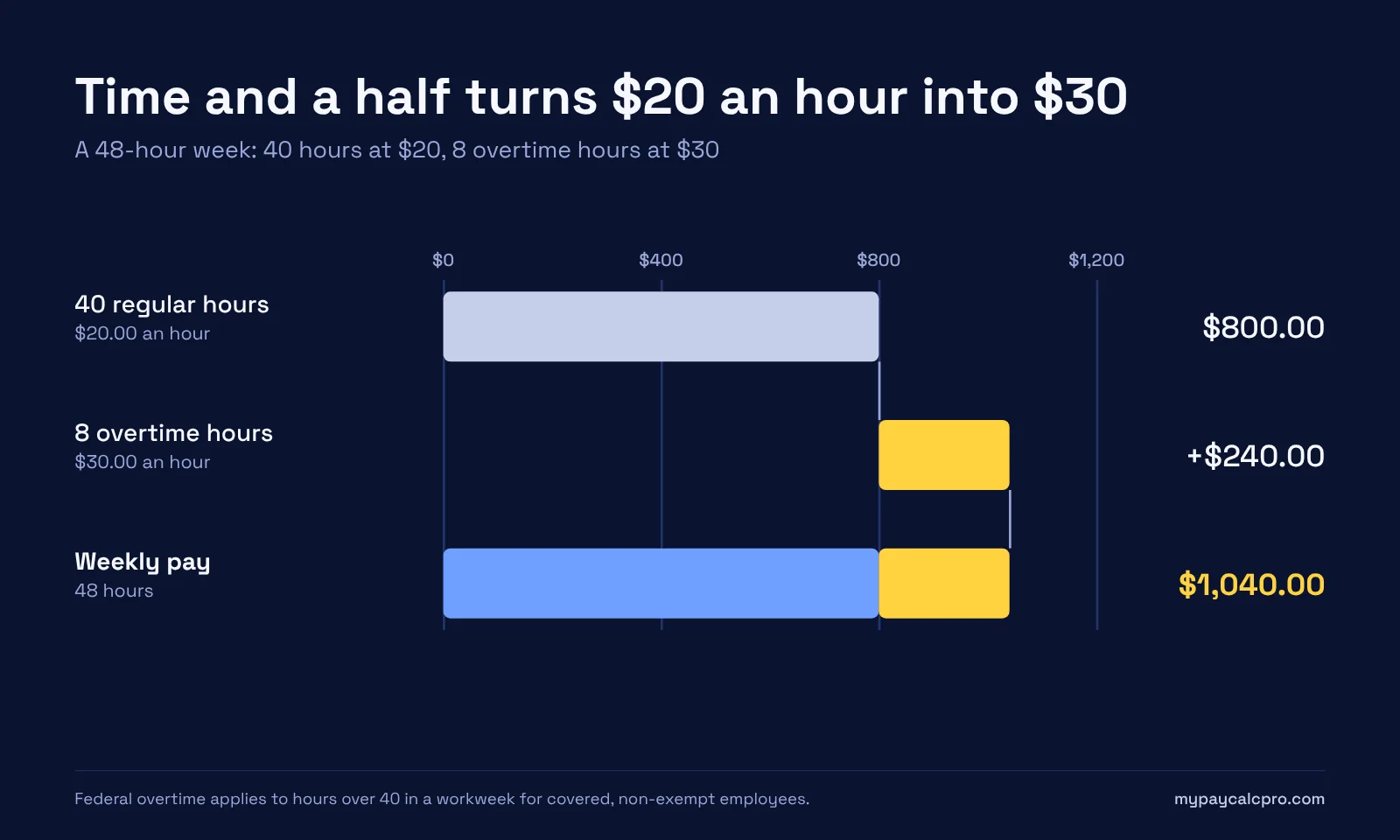
“Time and a half” means 150% of an employee's regular rate. If your regular rate is $20 per hour, time and a half is $30 per hour.
Time-and-a-half rate = regular rate × 1.5
For covered, nonexempt employees, the federal Fair Labor Standards Act (FLSA) generally requires at least time and a half for hours worked over 40 in a workweek. The federal rule is based on the regular rate, not necessarily the employee's basic hourly wage.
Try the numbers in the time and a half calculator or calculate the full week with the overtime calculator.
Why the regular rate matters
The FLSA's regular-rate calculation can include more than the employee's stated hourly wage. Depending on the payment, commissions, piece-rate earnings and certain nondiscretionary bonuses may affect the regular rate. Some payments are excluded by law.
That means an employee earning $18 per hour could have a regular rate above $18 for a particular workweek. The correct overtime calculation depends on the compensation actually covered by the applicable rules.
Does every overtime hour pay exactly 1.5 times?
Not necessarily. The federal FLSA establishes a minimum overtime premium for covered nonexempt employees. State law, an employment agreement, a collective bargaining agreement, or an employer policy can provide a different or higher premium. California, for example, has daily overtime and double-time rules for qualifying employees.
Time and a half for salaried employees
Being paid a salary does not automatically mean an employee is exempt from overtime. Under federal law, exemption depends on the applicable requirements, including duties and compensation tests. Some salaried employees remain overtime-eligible.
For a salaried nonexempt worker, the calculation can require converting the salary to an hourly regular rate for the relevant workweek and then applying the overtime premium. Do not assume that “salary” means “no overtime.”
What about taxes?
Overtime pay is still wages. The IRS treats overtime pay as supplemental wages for federal withholding purposes, although employers can use different withholding methods depending on how supplemental wages are paid. Withholding is not the same thing as your final federal income tax liability.
This distinction matters because a larger withholding amount on an overtime check does not automatically mean overtime has a special higher federal income-tax rate. Your final tax is determined under the applicable tax rules for your overall income.
Quick reference
| Regular rate | Time and a half |
|---|---|
| $15 | $22.50 |
| $20 | $30 |
| $25 | $37.50 |
| $30 | $45 |
| $40 | $60 |
Frequently asked questions
What does time and a half mean?
It means 1.5 times the applicable regular rate. A $20 regular rate becomes $30 at time and a half.
Is time and a half the same as overtime?
Often, but not universally. Federal overtime for covered nonexempt employees is generally at least 1.5 times the regular rate after 40 hours in a workweek. State rules and special situations can differ.
Is overtime taxed at a higher tax rate?
Overtime is taxable wage income, but a separately identified overtime payment may be withheld using supplemental-wage rules. Withholding and final tax liability are different concepts.
Sources: U.S. Department of Labor, Fact Sheet #23 and Fact Sheet #56A; IRS Publication 15 (2026). General information only, not legal or tax advice.
Try your own rate in the time and a half calculator.