By Muhammad Habib. Last reviewed October 2026.
The federal baseline
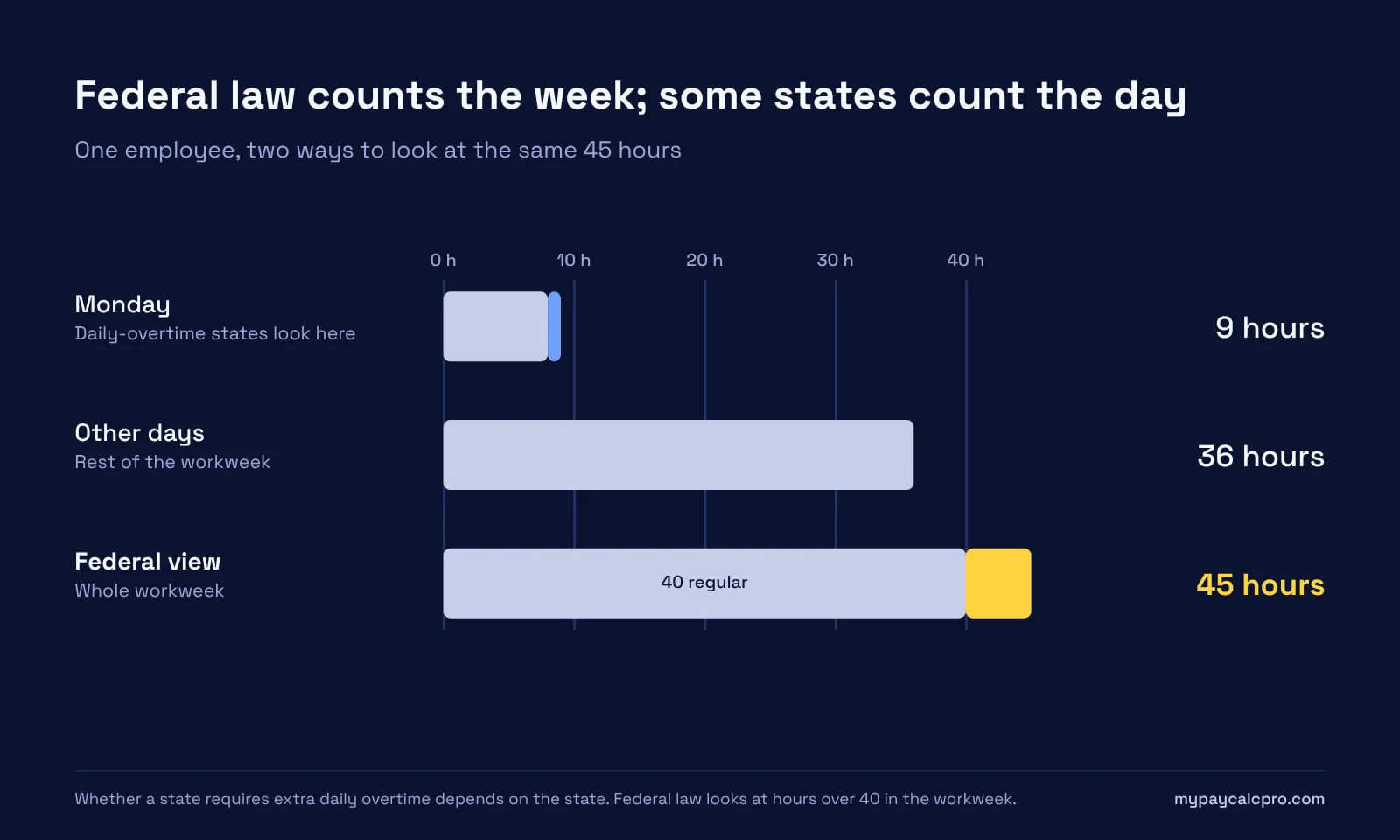
The Fair Labor Standards Act is the federal wage-and-hour law that establishes overtime standards for covered nonexempt employees. Under the general federal rule, overtime is due at not less than 1.5 times the regular rate for hours worked over 40 in a fixed workweek.
The federal rule does not generally require premium pay simply because work occurs on a Saturday, Sunday, holiday or regular day of rest. It also does not create a general daily overtime rule.
States can provide additional protections
The U.S. Department of Labor explains that the FLSA provides minimum standards and does not prevent states from establishing more protective standards. When both federal and state overtime laws apply, the employee is entitled to the standard that provides the greater benefit.
That can matter in several ways: a state may have daily overtime, a different definition of overtime-eligible work, stronger exemption requirements, or special rules for particular industries or schedules.
Why you should not use a generic calculator for every state
A calculator based only on the federal 40-hour rule can be useful for a general estimate, but it may not capture state-specific daily rules, alternative workweek schedules, industry exceptions, local requirements, or special employee classifications.
MyPayCalc Pro's general overtime calculator should therefore be read as a federal-style estimate unless a page specifically identifies a state rule. For California, use the dedicated California overtime calculator.
Exempt versus nonexempt
Before calculating overtime, determine whether the employee is covered and nonexempt. Under federal law, salary status alone does not automatically make a worker exempt. The Department of Labor says exemption tests can involve both compensation and duties. State law may impose additional requirements.
This is especially important for salaried employees. A salary can be converted to an hourly equivalent for comparison, but that mathematical conversion does not itself decide overtime eligibility.
Common state-law differences
- Daily overtime: Some states require overtime after a specified number of hours in a day.
- Seventh-day rules: Some states have special rules for working consecutive days.
- Double time: Certain jurisdictions require a higher premium after a particular threshold or in specific circumstances. See the double time calculator.
- Exemptions: State exemption tests can differ from federal tests.
- Industry rules: Agriculture, healthcare, transportation and other industries can have specialized rules.
How to check the rule that applies
Start with the federal FLSA, then identify the state where the employment is governed and check its labor department. If a local ordinance or employment agreement provides additional rights, those may also matter.
For a general federal estimate, use the overtime calculator. If your question involves a specific state, use a state-specific source rather than assuming the federal formula controls every detail.
Frequently asked questions
Does federal law override state overtime law?
Not when state law provides greater worker protection. The Department of Labor explains that the FLSA establishes minimum standards and states can provide more protective rules.
Is overtime always after 40 hours?
That is the general federal rule for covered nonexempt employees, but some state laws use additional daily or other overtime tests.
Does my job title decide whether I get overtime?
No. Under federal rules, exemption depends on the applicable tests, not simply a job title.
Sources: U.S. Department of Labor, Overtime, FLSA overview, and Fact Sheet #17A (white-collar exemptions). Laws vary by jurisdiction and can change. General information only.