By Muhammad Habib. Last reviewed October 2026.
The short answer
Non-exempt employees must be paid at least 1.5 times their regular rate for hours over 40 in a workweek. Exempt employees are not owed overtime under federal law. To be exempt, an employee must be paid on a salary basis, earn at least $684 a week and perform exempt duties. A job title or a salary alone does not decide it.
The three tests for exempt status
- Salary basis. The employee receives a fixed amount each pay period that is not reduced because of the quality or quantity of the work performed.
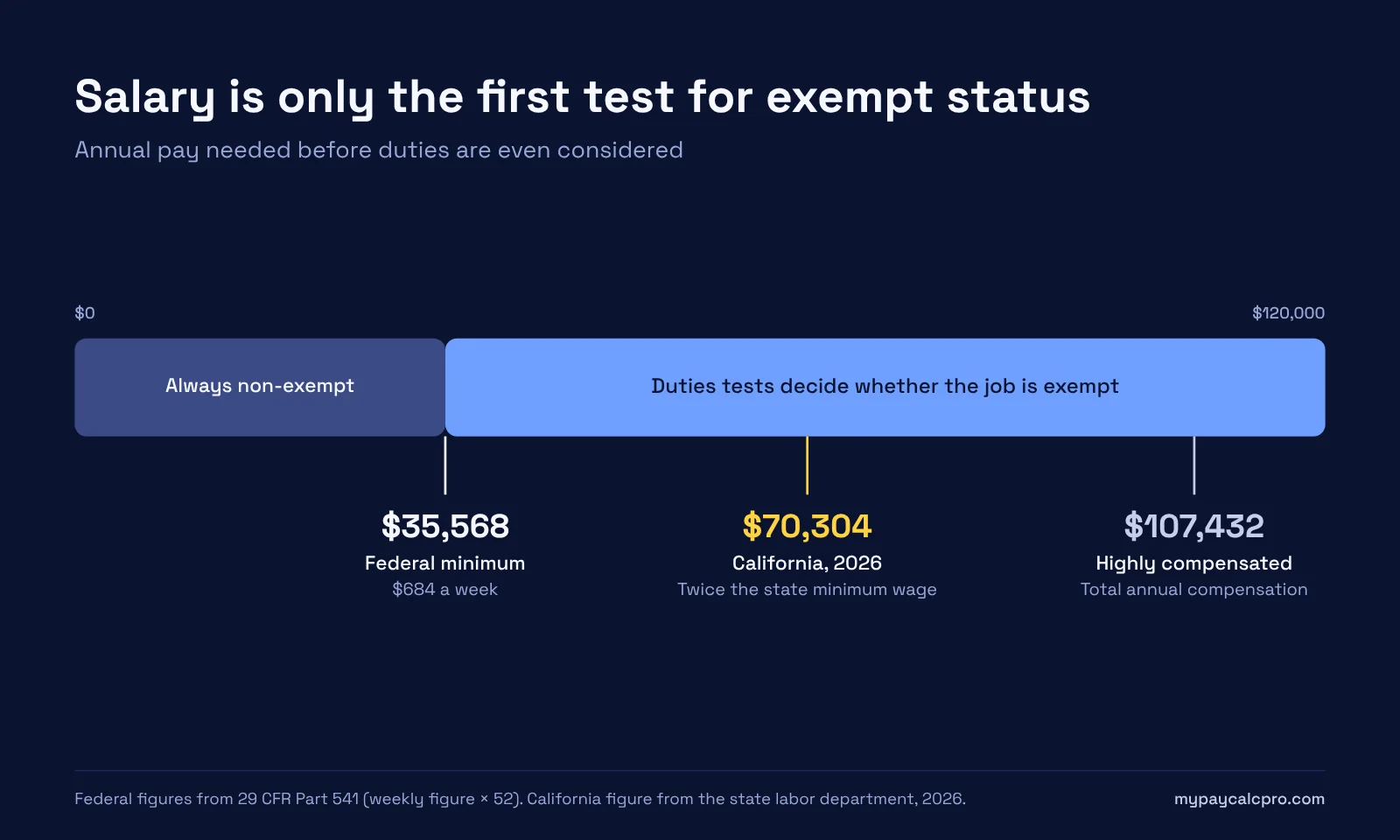
- Salary level. The pay must be at least $684 per week, which is $35,568 a year.
- Duties. The employee's primary duty must fit an exemption in the regulation. A job title alone is insufficient to establish exempt status.
Fail any one test and the employee is non-exempt, even with a salary and a manager title.
What the duties tests require
| Exemption | What the regulation requires |
|---|---|
| Executive | Primary duty is managing the enterprise or a department. Customarily and regularly directs the work of two or more other employees. Has authority to hire or fire, or whose suggestions on hiring, firing or promotion are given particular weight. |
| Administrative | Primary duty is office or non-manual work directly related to the management or general business operations of the employer or its customers. That duty includes exercising discretion and independent judgment on matters of significance. |
| Professional | Primary duty is work requiring advanced knowledge in a field of science or learning, or work requiring invention, imagination, originality or talent in a recognized artistic or creative field. |
A separate rule covers highly compensated employees, who have total annual compensation of at least $107,432 including at least $684 a week paid on a salary or fee basis. Computer and outside sales employees have their own exemptions as well.
Example: a salaried "manager" who is not exempt
Now take a $34,000 salary. That is $653.85 a week, below $684, so the employee is non-exempt whatever the duties are.
State rules can be stricter
Federal law sets the floor. Some states require a higher salary or different tests. In California, an exempt employee must earn at least twice the state minimum wage for full-time work, which is $70,304 a year in 2026, and California also requires overtime after 8 hours in a day. See federal vs state overtime rules and California overtime rules explained.
What to check on your own job
- Is your pay a fixed salary, and is it at least $684 a week (more in some states)?
- Do your real day-to-day duties match one of the exemptions above, not just your title?
- If you are non-exempt, track hours and run them through the overtime calculator.
- If you are unsure, the U.S. Department of Labor Wage and Hour Division can answer questions about your status.
Frequently asked questions
Can a salaried employee get overtime?
Yes. Being salaried does not make an employee exempt. A salaried employee who does not meet the salary level and duties tests is non-exempt and must be paid overtime for hours over 40 in a workweek.
What is the minimum salary to be exempt from overtime?
Under the federal regulation, $684 per week, which is $35,568 a year, and the employee must also pass a duties test. Some states set a higher minimum, such as $70,304 a year in California for 2026.
Does a manager job title make someone exempt?
No. A job title alone is insufficient. The employee's actual salary and duties must meet the requirements of the regulation.
Sources: U.S. Department of Labor, Fact Sheet #17A: Exemption for Executive, Administrative, Professional, Computer and Outside Sales Employees; 29 CFR Part 541, eCFR; California Department of Industrial Relations, 2026 minimum wage release. Rules reviewed October 2026. Exemption status depends on the facts of each job, so confirm with the Department of Labor or your state labor department. This guide is general information, not legal, tax or payroll advice.