By Muhammad Habib. Last reviewed October 2026.
The short answer
Under the federal Fair Labor Standards Act (FLSA), most non-exempt employees must be paid at least one and a half times their regular rate for hours worked over 40 in a workweek.
Overtime pay = regular rate × 1.5 × overtime hours
Total pay = regular pay + overtime pay
What is overtime pay?
Overtime pay is the extra pay a covered, non-exempt employee earns for hours worked over 40 in a workweek. Under the federal Fair Labor Standards Act it is at least one and a half times the regular rate of pay. The U.S. Department of Labor explains the rule in Fact Sheet #23.
Your workweek sets the 40 hours
The 40-hour test applies to a workweek, which the Department of Labor defines as a fixed and regularly recurring period of 168 hours, or seven consecutive 24-hour periods. Your employer chooses when the workweek starts, but it cannot move it around to avoid overtime.
Hours cannot be averaged over two or more weeks. If you work 30 hours one week and 50 the next, you are owed 10 hours of overtime for the second week. The slow week does not cancel it.
What counts as your regular rate
Your regular rate is not always your hourly wage. It generally includes all pay for the week, such as nondiscretionary bonuses. You find it by dividing your total straight-time earnings by the hours you worked, then paying a half-time premium on the overtime hours.
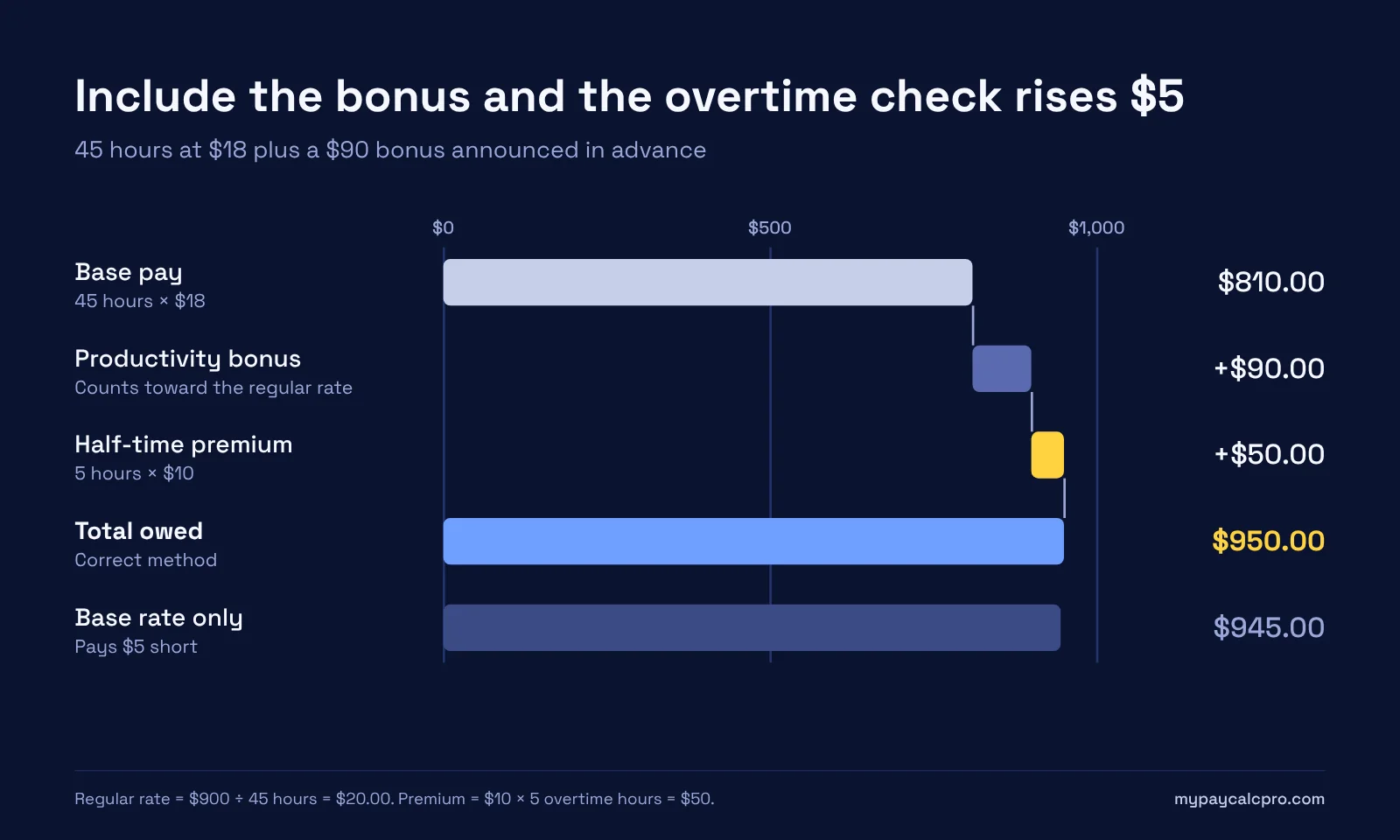
A bonus that is truly discretionary, where the employer decides both whether to pay it and how much, is generally left out of the regular rate. Most bonuses tied to announced goals are not discretionary.
Salaried non-exempt employees
A salary does not remove the right to overtime. Employees who are not exempt are still owed it. The Department of Labor's example is a worker paid $405 for a 45-hour week. The regular rate is $405 ÷ 45 = $9.00, and the employee is owed an extra $4.50 for each of the 5 overtime hours, which is $22.50.
Whether you are exempt depends on both how much you are paid and the duties you perform. A job title or a salary alone does not decide it.
What federal law does not require
The FLSA does not require extra pay for work on weekends, holidays or days of rest, as such. It also has no daily overtime rule. Some states add their own rules. California, for example, requires overtime after 8 hours in a day and double time after 12, which is covered in the California overtime calculator. Check with your state labor department to see what applies to you.
Common mistakes
- Ignoring bonuses. Using only the base wage when a nondiscretionary bonus applies underpays overtime.
- Averaging weeks. Overtime is worked out one workweek at a time.
- Counting paid time off. Under the FLSA, overtime is based on hours actually worked, so paid vacation or holiday hours do not count toward the 40, unless your employer's policy or state law says otherwise.
- Treating a salary as a flat price. A fixed salary for a long workweek does not cover overtime owed to a non-exempt employee.
Try it with your numbers
Use the overtime calculator for your weekly pay, the overtime hours calculator to total your hours, the time and a half calculator for your overtime rate, and the overtime tax calculator to see how overtime affects your taxes.
Frequently asked questions
What is overtime pay?
Overtime pay is the extra pay a non-exempt employee earns for hours worked over 40 in a workweek. Federal law sets it at no less than 1.5 times the regular rate of pay.
Does an employer have to pay overtime after 40 hours?
Yes, for most non-exempt employees the federal Fair Labor Standards Act requires overtime pay after 40 hours in a workweek. Employees who qualify as exempt are not covered, and some states add daily overtime rules, so check yours.
How do you calculate overtime pay?
Multiply your regular rate by 1.5, then multiply that by your overtime hours. Add the result to your pay for the first 40 hours.
Is overtime always 1.5 times my hourly wage?
The federal minimum is 1.5 times your regular rate, and your regular rate can be higher than your base wage if you earn nondiscretionary bonuses. Some employers or state laws pay more.
Do paid vacation days count toward 40 hours?
Under the FLSA, no. Overtime is based on hours actually worked, unless your employer's policy or state's law says otherwise.
Does my employer have to pay double time?
Not under federal law. Some states, such as California, require it in certain situations, and some employers offer it voluntarily.
Sources: U.S. Department of Labor, Fact Sheet #23: Overtime Pay Requirements of the FLSA, and the Wage and Hour Division's overtime pay page. This guide is general information, not legal advice.
Apply the formula: enter your hours and rate to see the result, or split your daily hours first. To add up hours from start and end times, use the time card calculator.