By Muhammad Habib. Last reviewed October 2026.
The short answer
There is no separate federal tax rate for overtime. It is taxed as ordinary wages at your normal bracket rates. A check may show 22% withholding when payroll uses the supplemental-wage method, but that is withholding, not your tax rate. For 2025 to 2028, up to $12,500 ($25,000 joint) of the overtime premium is deductible.
The important distinction: tax vs. withholding
There is no separate federal income-tax rate that automatically applies just because earnings are called “overtime.” Overtime is compensation for work and is generally included in wages. What often causes confusion is the way an employer withholds federal income tax from a particular paycheck.
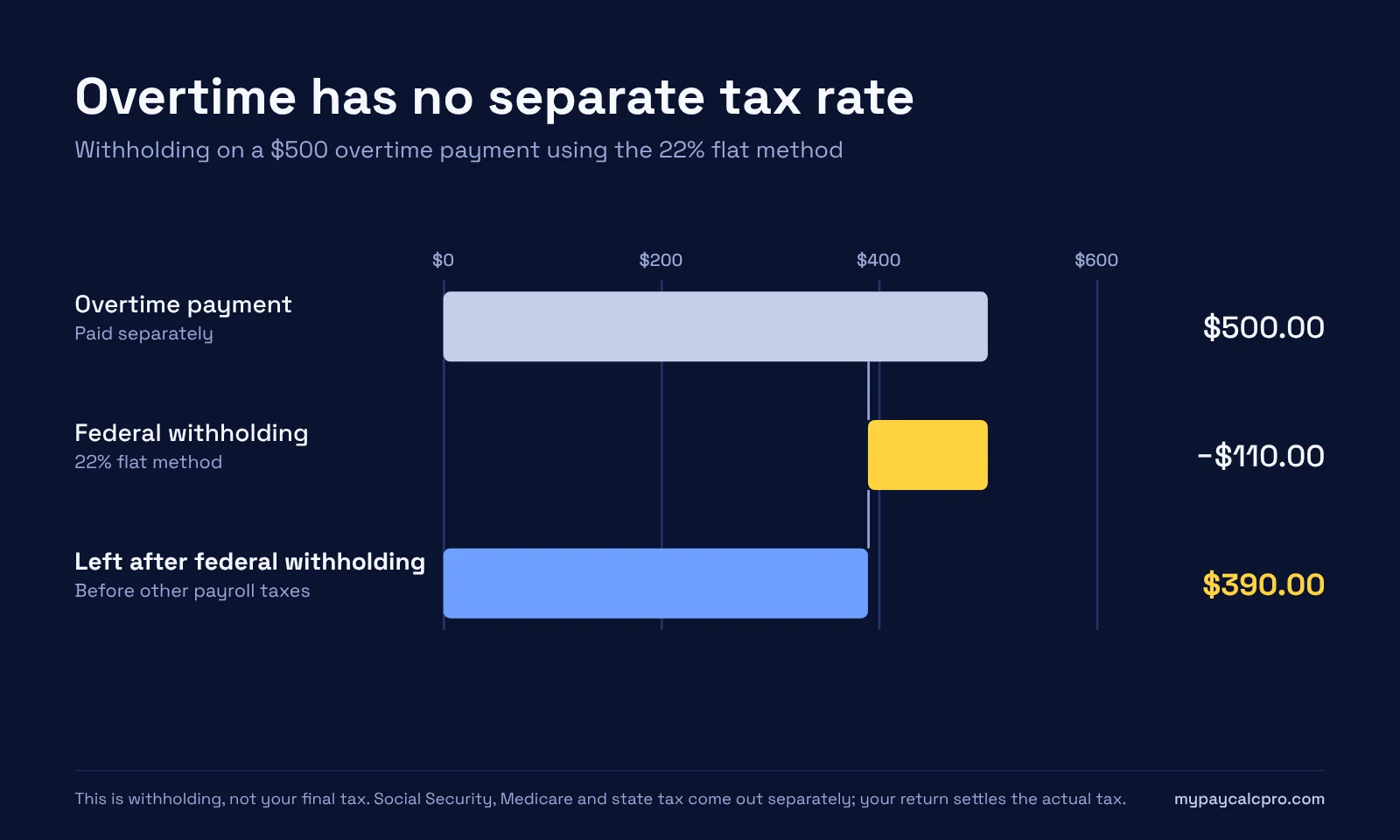
The IRS treats overtime pay as a type of supplemental wage. When supplemental wages are separately identified, an employer may use a special withholding method. For 2026, IRS Publication 15 describes a 22% flat withholding method for qualifying separately identified supplemental wages of $1 million or less when the applicable conditions are met. Employers can also use an aggregate method in situations described by the IRS.
Why your overtime check can look heavily taxed
Imagine your normal paycheck has ordinary wages and your overtime is added as a separate payment. Payroll may apply supplemental-wage withholding rules to that additional amount. The resulting withholding can look different from the withholding on a normal paycheck.
That number is a withholding amount, not a calculation of your final annual tax bill. Your actual federal income tax is determined after considering your total taxable income, deductions, credits and other applicable rules.
What about Social Security and Medicare?
Overtime wages are generally subject to payroll taxes as wages. The amount withheld for Social Security and Medicare depends on the applicable wage limits and rules, not simply on whether a payment is overtime.
For higher earners, payroll-tax calculations can also involve wage thresholds and additional Medicare tax rules. Those calculations are separate from federal income-tax withholding.
For 2026, Social Security tax is 6.2% on wages up to $184,500, and Medicare tax is 1.45% on all wages. Employers also withhold an extra 0.9% Additional Medicare Tax on wages above $200,000.
Can overtime push you into a higher tax bracket?
Additional taxable income can increase the portion of your income that falls into a higher marginal federal tax bracket. It does not normally cause all of your income to be taxed at that higher rate. Marginal brackets apply to successive portions of taxable income.
This is why “my overtime was taxed at 22%” is often an oversimplification. A 22% withholding method, if used by payroll, is not necessarily your effective or marginal tax rate for the year.
What about state income tax?
State and local rules vary. Some states have individual income taxes; others do not. Some local jurisdictions also impose income taxes. Your paycheck can therefore have federal income-tax withholding, Social Security, Medicare, and state or local withholding at the same time.
Use a state-specific calculator or consult the relevant tax authority when state withholding is important to your estimate.
The federal deduction for qualified overtime (2025 to 2028)
A separate rule can reduce your federal income tax. For tax years 2025 through 2028, you may deduct the premium part of overtime required by the Fair Labor Standards Act (the extra half in time and a half), up to $12,500, or $25,000 on a joint return. The deduction phases out above $150,000 of modified adjusted gross income ($300,000 joint), and married taxpayers must file jointly to claim it. You claim it when you file, on Schedule 1-A, so it generally does not change what your employer withholds from each paycheck. Payroll taxes still apply to the full overtime amount.
The overtime tax calculator estimates this deduction. For who qualifies and worked examples, see the no tax on overtime guide. Source: IRS Fact Sheet 2026-13.
How MyPayCalc Pro estimates overtime tax
The overtime tax calculator estimates your yearly federal income tax using the 2025 or 2026 brackets and standard deduction, with and without the qualified overtime deduction, and adds the Social Security and Medicare tax on the overtime. It is an estimate of yearly tax, not a payroll withholding statement. Your employer's payroll system may use different withholding methods, benefits, deductions or state rules.
Frequently asked questions
Does overtime have a special federal tax?
No separate federal income-tax rate applies solely because pay is overtime. Overtime is wage income, while the withholding method used for a particular payment can differ.
Why did my overtime check have more federal withholding?
Your employer may have treated the separately identified overtime as supplemental wages and used an applicable supplemental-wage withholding method. Withholding is not the same as final tax liability.
Is overtime tax-free now?
No. For tax years 2025 through 2028, the premium part of qualified overtime may be deductible on your federal return, up to $12,500 ($25,000 joint), subject to income limits. Social Security and Medicare tax still apply to overtime pay.
Can I get some of the withholding back?
If your total federal income-tax withholding exceeds your final federal income-tax liability, the difference can generally be reflected in your tax refund when you file. The opposite can also occur if too little was withheld.
Source: IRS Publication 15 (2026), Employer's Tax Guide. For individual tax situations, use current IRS guidance or a qualified tax professional. This guide is general information, not tax advice.
To test the deduction on your own hours, estimate the no tax on overtime deduction.