By Muhammad Habib. Last reviewed November 2026.
The short answer
"No tax on overtime" is a federal income tax deduction, not a tax exemption. For tax years 2025 through 2028 you can deduct the premium part of overtime pay that the Fair Labor Standards Act (FLSA) requires, up to $12,500 ($25,000 on a joint return). The deduction phases out when modified adjusted gross income is above $150,000 ($300,000 joint). Social Security and Medicare tax still apply to all of your overtime.
What counts as qualified overtime
Under the law, qualified overtime compensation is overtime pay required by section 7 of the FLSA that is more than your regular rate of pay. In plain terms, it is the "half" in time and a half. If you earn $30 an hour and are paid $45 for an overtime hour, only the extra $15 is deductible. The $30 base portion of that hour is not.
Deductible amount per overtime hour = regular rate × 0.5 (for time and a half)
Pay that your employer gives beyond what the FLSA requires, such as a holiday premium or daily overtime under a company policy, is generally not qualified overtime. State overtime rules that go beyond the FLSA, such as California daily overtime, are a place to check your W-2 rather than assume. Your employer reports the amount that qualifies. See federal vs state overtime rules for how the two differ.
Worked examples
These are estimates. Your real saving depends on your tax bracket and other income. To run your own hours, use the overtime tax calculator.
How the income phase-out works
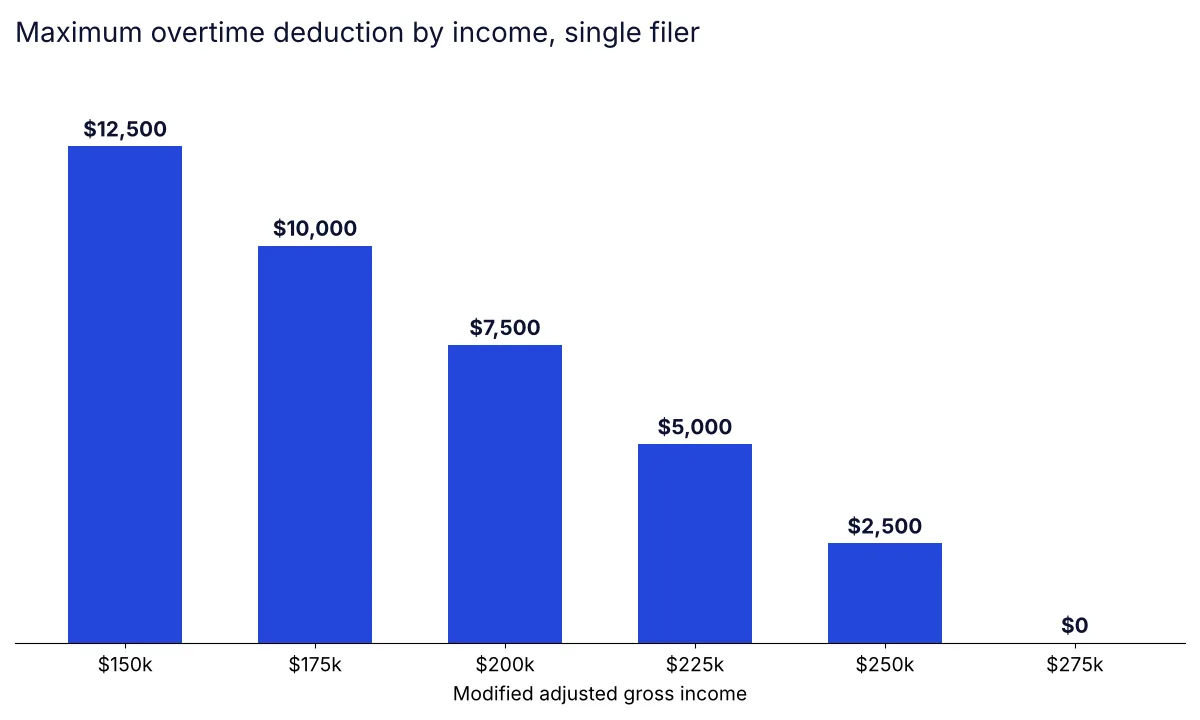
The $12,500 limit ($25,000 joint) is reduced by $100 for every $1,000 that your modified adjusted gross income (MAGI) is above $150,000 ($300,000 joint). The deduction can fall to zero.
Who can claim it
- You need a valid Social Security number on your return.
- Married couples must file a joint return to claim it.
- You can claim it whether you itemize or take the standard deduction.
- The overtime must be FLSA-required overtime. IRS guidance says a bona fide 20% owner-employee who actively manages the business generally is not eligible.
What it does and does not change
- Income tax: the deduction lowers your federal taxable income when you file.
- Paycheck withholding: employers must keep withholding federal income tax from overtime, so your paychecks do not change on their own. You can submit a new Form W-4 if you want less withheld.
- Social Security and Medicare: still taken from all overtime pay. See the FICA calculator.
- State tax: the deduction is federal. Your state decides separately whether to follow it.
Where to find the number on your W-2
Starting with tax year 2026, employers report qualified overtime in box 12 of Form W-2 with code TT. The IRS says you can generally claim the deduction only for the amount reported there, even if you cannot deduct all of it because of the limits. If the amount looks wrong, ask your employer for a corrected Form W-2c. For 2025 returns, employers were not required to report it separately, and the IRS pointed taxpayers to the Schedule 1-A instructions to work it out.
Frequently asked questions
Is overtime really tax-free now?
No. The deduction lowers your federal income tax, but overtime pay is still included in your income, and Social Security and Medicare tax still apply. Your employer must also keep withholding federal income tax from overtime.
How much overtime can I deduct?
Up to $12,500, or $25,000 on a joint return, for tax years 2025 through 2028. The limit applies to the premium part of qualified overtime, and it shrinks when your modified adjusted gross income is above $150,000 ($300,000 joint).
Does the deduction cover all my overtime pay?
No. Only the premium part counts: the extra half in time and a half, or the extra amount above your regular rate. The overtime must be required under the Fair Labor Standards Act, so extra pay your employer chooses to give, such as a holiday premium, generally does not qualify.
Do I get the deduction if I take the standard deduction?
Yes. IRS guidance says you can claim it whether you itemize or take the standard deduction. You also need a valid Social Security number, and married couples must file jointly.
Will my paycheck go up because of the deduction?
Not automatically. Employers must keep withholding on overtime, so most people see the benefit as a larger refund or a smaller bill when they file. If you want less withheld, you can submit a new Form W-4.
How do I find my qualified overtime amount?
From 2026, employers report it in box 12 of Form W-2 with code TT. You generally can claim the deduction only for the amount reported there. If you think the figure is wrong, ask your employer for a corrected Form W-2c.
Sources: IRS, One Big Beautiful Bill Act: tax deductions for working Americans and seniors (Fact Sheet 2025-03); IRS, What to know about the No Tax on Overtime deduction; 26 U.S.C. 225, Qualified overtime compensation. This guide is general information, not tax advice. Check current IRS guidance or ask a tax professional about your own return.
Estimate your own deduction with the overtime tax calculator, or see whether overtime is taxed differently.