By Muhammad Habib. Last reviewed October 2026.
California is different from the federal baseline
For many nonexempt employees, California overtime can apply based on hours worked in a workday as well as hours worked in a workweek. That is an important difference from the general federal FLSA rule, which uses a 40-hour workweek for ordinary overtime.
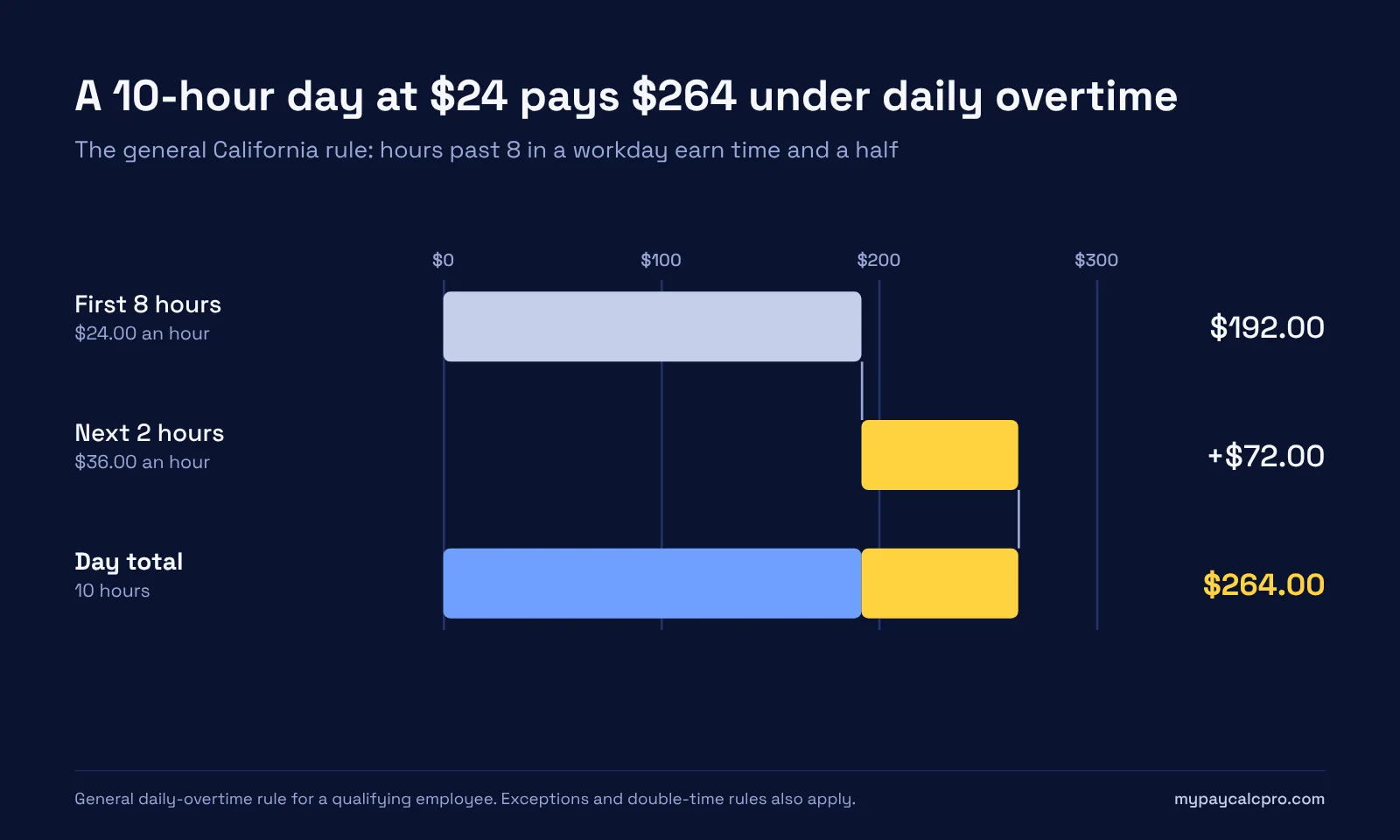
California's Department of Industrial Relations states that the general rule for covered nonexempt adult employees is 1.5 times the regular rate for hours worked over 8 through 12 in a workday, and for the first 8 hours worked on the seventh consecutive day of a workweek. Double time generally applies to hours over 12 in a workday and hours over 8 on the seventh consecutive day.
Daily overtime
Under the general California rule, qualifying hours over 8 and up to 12 in a workday are paid at 1.5 times the regular rate. Hours over 12 in the same workday are generally paid at double the regular rate.
Weekly overtime
California also has a 40-hour workweek rule. If an employee works more than 40 hours in a workweek, overtime can apply even if no individual day exceeds 8 hours. There are exceptions and special rules, so a complete calculation must consider the employee's schedule and classification.
Seventh consecutive day
The California Department of Industrial Relations explains that, under the general rule, the first 8 hours worked on the seventh consecutive day in a workweek are paid at 1.5 times the regular rate, while hours beyond 8 on that seventh day are generally paid at double time.
Double time
Double time means twice the applicable regular rate. At a $24 regular rate, double time is $48 per hour. It is not the same as ordinary federal overtime and should not be assumed to apply to every long workday. To price double-time hours, use the double time calculator.
Alternative workweek schedules and exceptions
California has exceptions and alternative workweek provisions. Industry-specific wage orders can also affect the exact rule. This guide describes the general framework and should not be used to decide a specialized employment classification.
How to use the calculator
The California overtime calculator is intended as an estimate based on the inputs you provide. Enter your regular rate and the relevant hours, then review the result and assumptions. For a general federal calculation, use the federal-style overtime calculator.
Common mistakes
- Using only the weekly 40-hour rule: daily overtime can matter.
- Ignoring the seventh day: consecutive-day rules can change the premium.
- Using the base wage automatically: California overtime is based on the applicable regular rate.
- Ignoring industry rules: wage orders and exceptions can change the calculation.
Frequently asked questions
Is overtime after 8 hours in California?
Under the general rule for many nonexempt employees, hours over 8 in a workday are generally overtime at 1.5 times the regular rate through 12 hours.
When is double time required?
Under the general rule, hours over 12 in a workday and hours over 8 on the seventh consecutive day are generally paid at double time. Exceptions can apply.
Does California also have weekly overtime?
Yes. The general rule includes overtime after 40 hours in a workweek, subject to exceptions and special rules.
Source: California Department of Industrial Relations, Overtime FAQ. California wage orders and exemptions can vary by occupation and industry. This guide is general information, not legal advice.