By Muhammad Habib. Last reviewed October 2026.
The basic formula
To estimate an hourly equivalent from an annual salary, divide the salary by the number of paid work hours represented by the year.
Hourly equivalent = annual salary ÷ (hours per week × workweeks per year)
A common assumption is 40 hours per week for 52 weeks, or 2,080 hours per year.
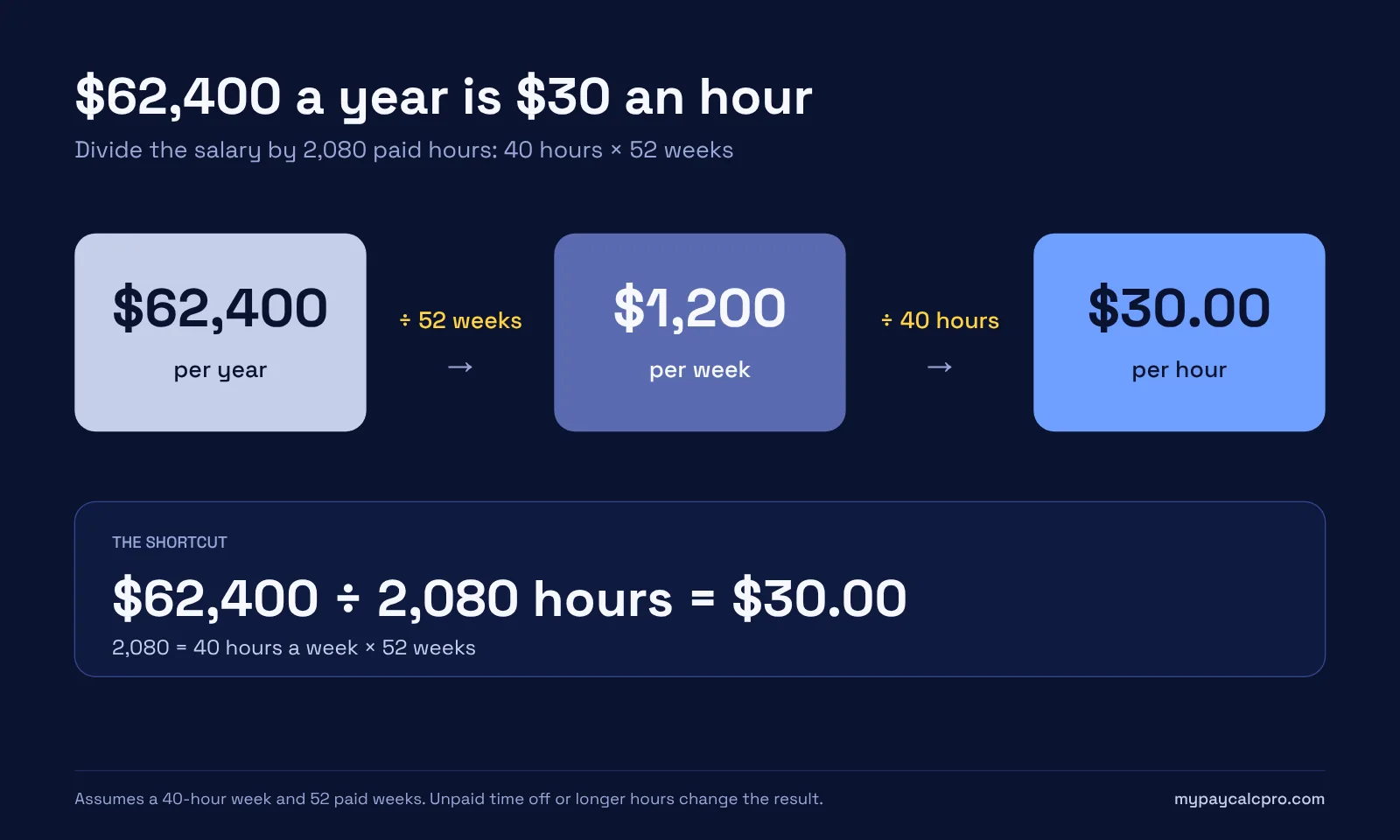
You can enter your own salary, weekly hours and weeks per year in the salary-to-hourly calculator.
Why 2,080 hours is only an assumption
Two salaried employees can have the same annual salary but different work schedules. If one normally works 40 hours and another works 37.5, their hourly equivalents are different even though the annual salary is identical.
Likewise, paid vacation and holidays can affect how you interpret an “hourly equivalent.” The calculator is a mathematical conversion; it does not determine whether a salaried employee is legally exempt from overtime or how an employer must calculate a regular rate.
Common annual salary conversions
| Annual salary | 40 hrs/week, 52 weeks |
|---|---|
| $40,000 | $19.23/hr |
| $50,000 | $24.04/hr |
| $60,000 | $28.85/hr |
| $75,000 | $36.06/hr |
| $100,000 | $48.08/hr |
Converting monthly or biweekly pay
If you know a monthly salary, multiply it by 12 to estimate the annual salary before applying the hourly formula. For biweekly pay, multiply a regular biweekly amount by 26. Be careful with pay periods: biweekly means every two weeks, while semimonthly means twice per month and normally produces 24 payments per year.
Does salary-to-hourly conversion determine overtime?
No. It gives you an equivalent hourly figure based on your assumptions. Overtime eligibility and the overtime regular rate are separate legal questions. Under the FLSA, a salaried employee can still be nonexempt and entitled to overtime. The Department of Labor notes that job titles and salary alone do not determine exemption status.
For overtime calculations, use the overtime calculator and read how overtime is calculated to understand the regular-rate concept.
What if I work 37.5 hours per week?
Use your actual normal schedule if you want an hourly-equivalent estimate. For example, $60,000 ÷ (37.5 × 52) = about $30.77 per hour. The result is higher than the $28.85 estimate produced by the 40-hour assumption because the same salary is spread across fewer scheduled hours.
Salary versus hourly pay
An hourly equivalent can help compare compensation, but it does not capture every employment benefit. Health insurance, retirement contributions, paid leave, bonuses, equity, shift differentials and other benefits can materially affect the overall value of a job.
Frequently asked questions
How many hours are in a full-time work year?
2,080 hours is the common calculation for 40 hours per week × 52 weeks. It is a convention for comparison, not a universal legal definition of full-time work.
How do I convert $50,000 to hourly?
Using 40 hours per week and 52 weeks, $50,000 ÷ 2,080 = about $24.04 per hour.
Should I subtract vacation?
Only if your purpose requires an estimate based on actual hours worked rather than the conventional 2,080-hour comparison. State your assumption so the result is transparent.
For overtime eligibility and regular-rate rules, see the U.S. Department of Labor's overtime guidance. This calculator and guide provide estimates and are not legal or employment advice.
Do it instantly with the salary to hourly calculator, or reverse it with hourly to salary.