By Muhammad Habib. Last reviewed October 2026.
The short answer
A W-2 employee splits Social Security and Medicare tax with the employer: 7.65% from the employee and 7.65% from the employer. A 1099 contractor pays both halves as self-employment tax, and no one withholds anything from the paycheck. At the same income, the contractor takes home less, and needs to earn about 7.5% more to end up in the same place.
Self-employment tax = 92.35% x net earnings x 15.3% (12.4% Social Security up to $184,500 plus 2.9% Medicare)
W-2 vs 1099 side by side
| W-2 employee | 1099 contractor | |
|---|---|---|
| Income tax | Withheld by the employer each paycheck | Nothing withheld; you pay it, usually as estimated payments |
| Social Security and Medicare | 7.65% from you, 7.65% from the employer | 15.3% of 92.35% of net earnings; you can deduct half |
| Overtime | Required for non-exempt employees over 40 hours | Not covered if truly independent |
| Benefits | Often health insurance, retirement match, paid leave | You buy your own |
| Business expenses | Generally not deductible as an employee | Deductible against your business income |
Example: $60,000 as W-2 and as 1099
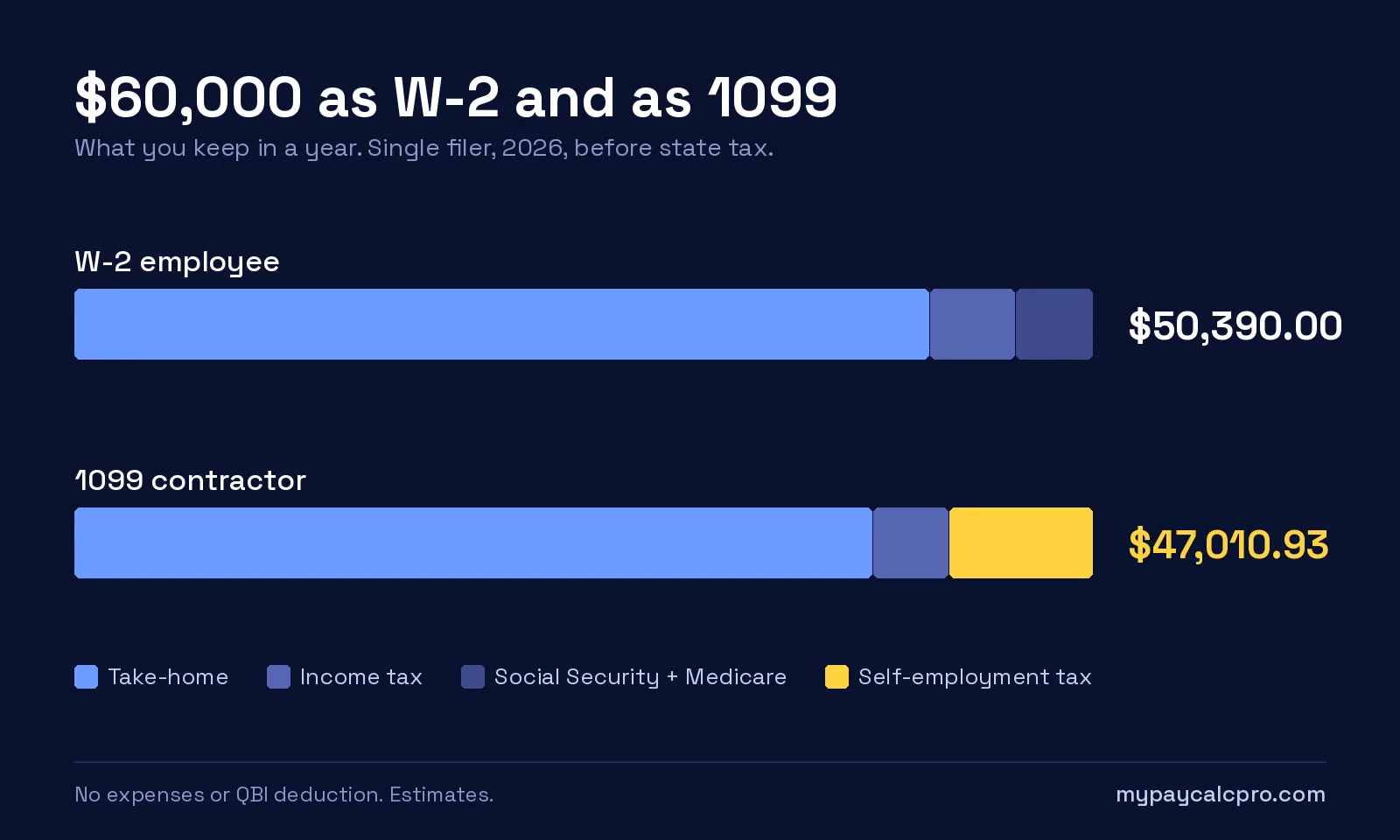
These figures use the 2026 standard deduction of $16,100 and the 2026 single brackets. They ignore state tax, business expenses, benefits and the QBI deduction.
What a 1099 contractor needs to earn to match W-2 pay
| W-2 salary | 1099 income needed to keep the same take-home |
|---|---|
| $50,000 | $53,769 |
| $60,000 | $64,522 |
| $75,000 | $80,646 |
| $100,000 | $107,528 |
Each row is about 7.5% higher than the salary. That difference is the employer half of Social Security and Medicare tax that a contractor must cover. It does not include the value of employer benefits, so a contractor also has to replace health insurance, retirement savings and time off.
Are you really a contractor?
A 1099 form does not decide your status. The Department of Labor looks at the working relationship, including who controls the work, who profits or loses, and whether you are in business for yourself. If you are treated as a contractor but work like an employee, you may be owed overtime. See exempt vs non-exempt overtime and the overtime calculator for what overtime is worth.
Assumptions and limits
- Single filer, standard deduction, no other income.
- The 1099 worker has no business expenses, and no QBI deduction is applied.
- State and local taxes are left out. The no-income-tax states guide covers where state tax is zero.
- Above the Social Security wage base of $184,500 and above $200,000 of income, extra rules apply, including Additional Medicare Tax.
Frequently asked questions
Do 1099 workers pay more tax than W-2 employees?
On the same income, usually yes. A W-2 employee pays 7.65% Social Security and Medicare tax and the employer pays the other 7.65%. A 1099 worker pays both halves as self-employment tax, 15.3% of 92.35% of net earnings, and can deduct half of it. In the $60,000 example below, the 1099 worker keeps about $3,379 less.
How much more must a 1099 worker earn to match W-2 pay?
About 7.5% more in the examples here: $64,522 of 1099 income to match a $60,000 W-2 salary, before business expenses, benefits and state tax. That covers the employer half of Social Security and Medicare tax. Health insurance, retirement contributions and paid time off are extra.
Do 1099 workers get overtime?
Independent contractors are not covered by the federal minimum wage and overtime rules. But a 1099 form or contractor agreement does not decide your status. The Department of Labor looks at how the work really operates, and a worker treated as a contractor can still be an employee entitled to overtime.
Is tax withheld from 1099 income?
No. The payer sends the full amount, and you are responsible for income tax and self-employment tax, usually through estimated tax payments during the year. Set money aside from every payment.
Does the 1099 example include the QBI deduction?
No. Many self-employed people can deduct up to 20% of qualified business income, which can lower income tax. The example leaves it out so the numbers are easy to follow, so your real tax may be lower.
Sources: IRS Topic No. 554, Self-employment tax; IRS, Qualified business income deduction; U.S. Department of Labor, Fact Sheet #13: Employment relationship under the FLSA; IRS Publication 15-T (2026), Federal Income Tax Withholding Methods; Social Security Administration, contribution and benefit base. Rules reviewed October 2026. Tax rules change, so confirm current figures with the IRS or a tax professional.
To see the W-2 side for your own pay, estimate your take-home pay, check how FICA tax is figured, or convert an hourly rate to a yearly salary first.