By Muhammad Habib. Last reviewed October 2026.
The short answer
Alaska, Florida, Nevada, New Hampshire, South Dakota, Tennessee, Texas, Washington and Wyoming do not tax wage income. Your paycheck in these states still has federal income tax, Social Security (6.2%) and Medicare (1.45%) taken out. What you save is the state income tax line, which in other states is often 3% to 6% of wages.
The nine states and what to know
| State | State income tax on wages | Other employee-paid payroll items |
|---|---|---|
| Alaska | None | Unemployment insurance, 0.50% of wages up to $54,200 in 2026 (up to $271 a year) |
| Florida | None | Check your pay stub |
| Nevada | None | Check your pay stub |
| New Hampshire | None | Check your pay stub |
| South Dakota | None | Check your pay stub |
| Tennessee | None | Check your pay stub |
| Texas | None | Check your pay stub |
| Washington | None | WA Cares Fund, 0.58% of all wages; Paid Family and Medical Leave, employee share of a 1.13% premium (71.43%, about 0.81%) up to $184,500 |
| Wyoming | None | Check your pay stub |
The table lists only the items confirmed with the state agencies named in the sources. Rates and rules change, so compare it with your pay stub.
Example: the same paycheck in three states
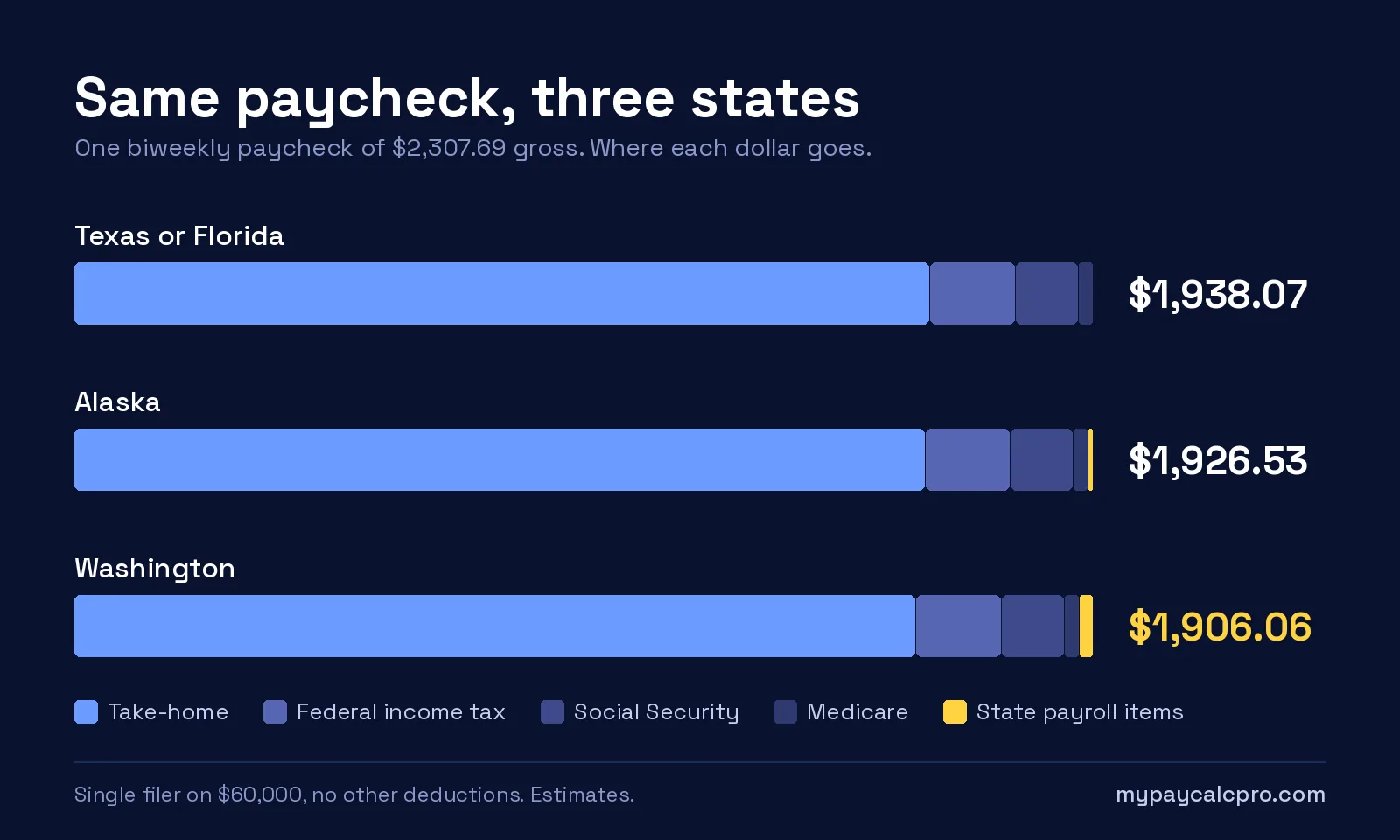
These Alaska and Washington figures are estimates that assume no other deductions. Alaska's contribution stops once your wages reach $54,200 for the year.
How to estimate it with the paycheck calculator
In the paycheck calculator, leave State income tax on None for most of these states. The calculator does not include state payroll items, so for Washington choose a flat rate of about 1.39% (0.58% plus 0.81%) and for Alaska about 0.5% to approximate them.
Does no income tax mean more take-home pay?
On the paycheck itself, yes: there is one less tax line. But no income tax does not mean lower costs overall, because these states collect revenue through sales, property and business taxes. Compare the whole picture before choosing where to work.
Where you work matters
State income tax usually follows the state where you do the work, not only where you live. A remote worker or commuter can have another state's tax withheld. The rules for overtime and pay also vary by state, as covered in federal vs state overtime rules.
Frequently asked questions
Which states have no income tax on wages?
Alaska, Florida, Nevada, New Hampshire, South Dakota, Tennessee, Texas, Washington and Wyoming do not tax wage income. You still pay federal income tax, Social Security and Medicare.
Do I still pay federal tax in a state with no income tax?
Yes. Federal income tax, Social Security tax and Medicare tax are taken out of your paycheck in every state. A state with no income tax only removes the state income tax line.
Does Washington take anything out of my paycheck?
Yes, even though it has no income tax on wages. Employees pay WA Cares Fund premiums of 0.58% of gross wages and most of the Paid Family and Medical Leave premium, about 0.81% in 2026. Employers may choose to cover some of it.
Do no-income-tax states have higher other taxes?
They raise money in other ways, such as sales, property and business taxes, so no income tax does not mean lower taxes overall. This guide covers paychecks only.
What if I live in one of these states but work in another?
State income tax usually follows where you work. If you live in Texas but work in a state that taxes wages, that state's tax can be withheld from your pay. Check with your employer or the state tax agency.
Sources: Washington Paid Family and Medical Leave, 2026 premiums; Washington WA Cares Fund, employer information; Alaska Department of Labor, 2026 unemployment insurance rates; IRS Publication 15-T (2026), Federal Income Tax Withholding Methods; Social Security Administration, contribution and benefit base. Rules reviewed October 2026. State rules change, so confirm current figures with your state agency.
Want your own number? Estimate your take-home pay, see what FICA takes, or work out the gross pay behind a take-home target.